 |
One of a kind!
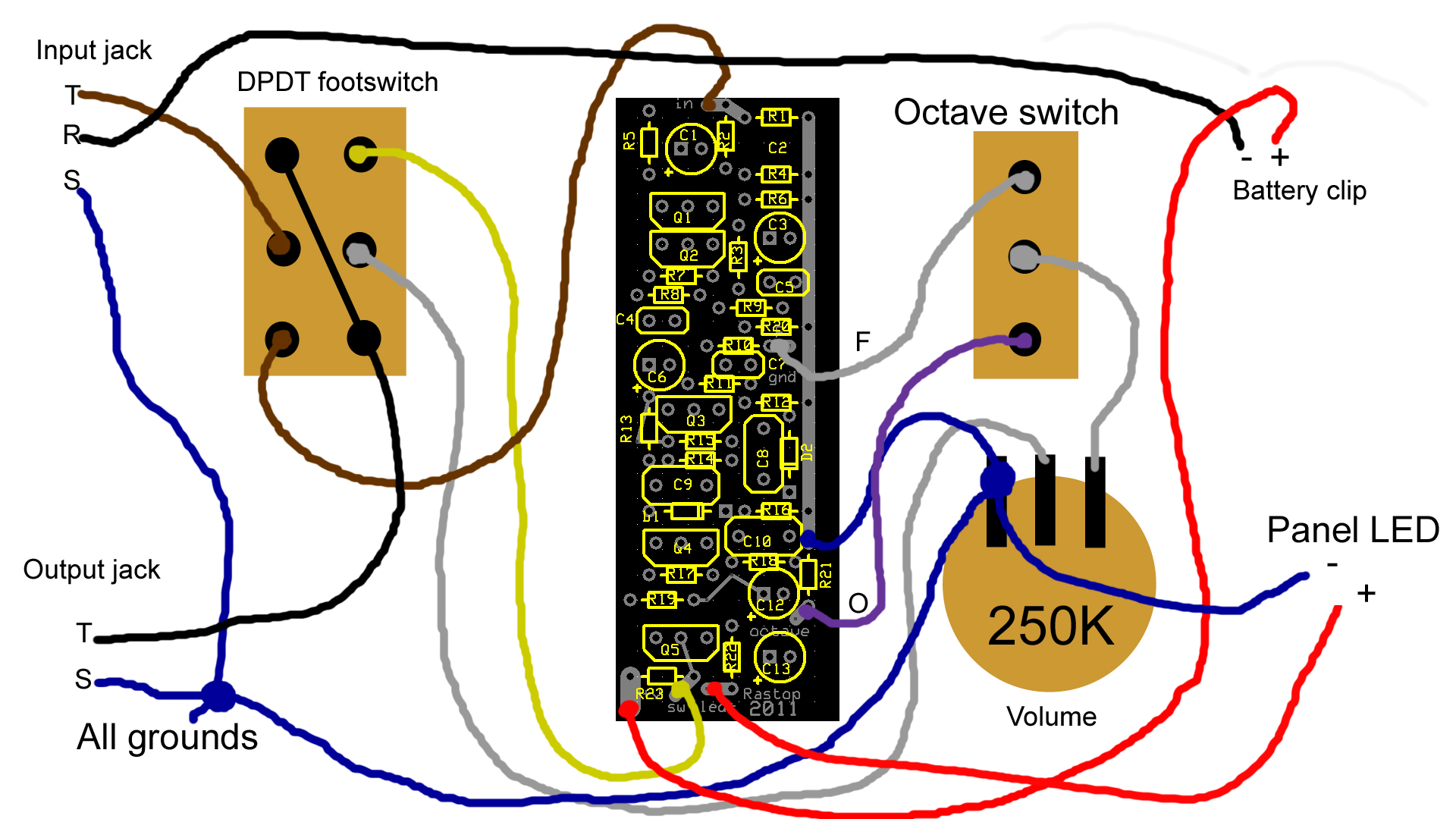
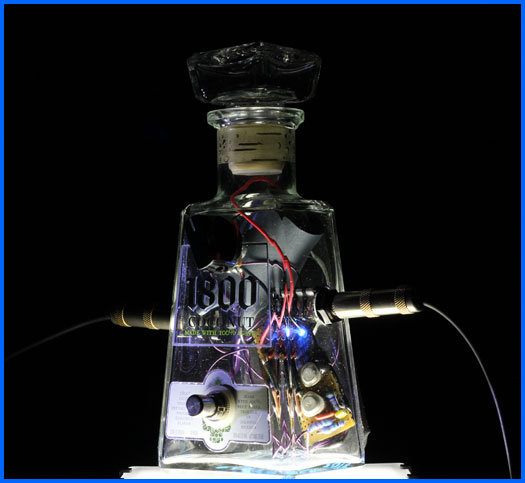
1800 Tequila (coconut) Fuzz Face, low noise germanium transistors, one knob (Volume), see-through LED indicator, long battery life.
Direct price: $300.00
|
|
|
Fuzzes 2013
Ekasilicon series- hybrid designs combining Silicon and Germanium transistors.
Ekasilicon T-tone - two knobs Fuzz Face with switchable Tone circuit.
Ekasilicon Fuzz Pie - combination of Harmonic Percolator and transformer-based Octavia.
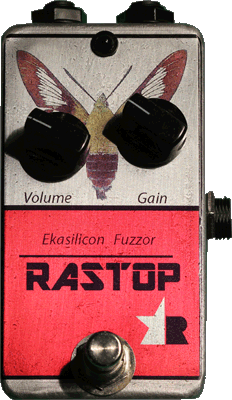
Ekasilicon Fuzzor - straight-forward fuzz, with compression at max gain setting, cleans up nice with guitar volume, demo on Youtube.
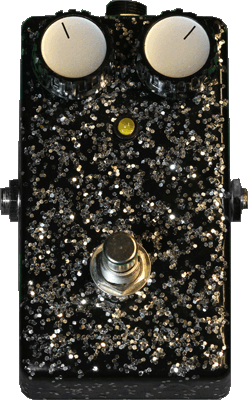
Glitter Fuzz - modern sounding, with hard cut-off.Reproduces guitar tones perfectly, total control with Vol. and Fuzz knobs!
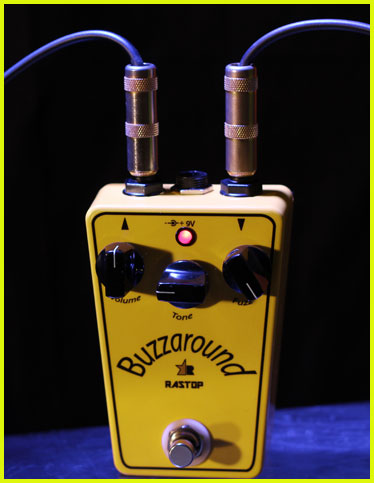
Buzzaround - for Burns Buzzaround freaks.
All updated Germanium Schmitt-Octave Fuzz.
Messin'ger - built-in Fuzz for guitars, wake up Mark Farner!
|
|
|
New!
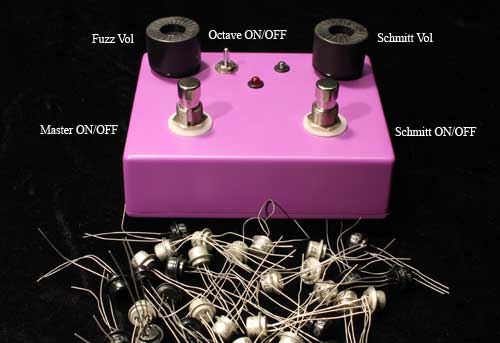
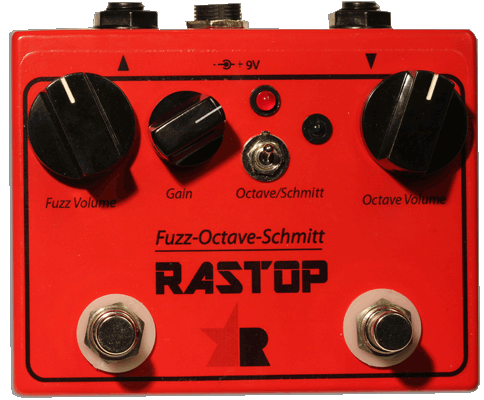
Germanium Schmitt Fuzz
Combination of Fuzz Face, Octavia and Schmitt Trigger Fuzz. Using low noise military Russian Germanium transistors. Check Youtube videos at Rastop1 channel!

|
|
Strat with compressor
12 string electric with compressor
|
New Compressor,
dual 15V power supply!
updated- July 2008
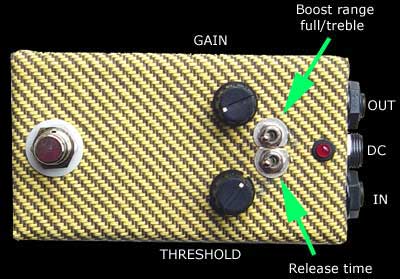
The latest modification of Compressor - optocoupler- based (NSL32), dual 15 volt power supply, DC/DC converter accepts 9-15DC volt input, Boss-type , center negative jack. ( No battery, for use on the pedal board with power supply). Extended headroom, works well with a 12 string electrics - both humbuckers and single coils.
Mini-switch for selecting the boost range, choose Full or Treble(cuts low freqs, good for taming muddy sound).
Mini-switch for release time select, short release time gives that "clack" sound, very good for single notes riffs.
Listen to new samples!
|
|
Single coil neck pickup, tone at the middle
bridge humbucker, tone full CW
bridge humbucker,tone full CCW
|
60's Fuzz
They say that "Beatles" tune "Revolution" with nasty fuzz sound was actually recorded straight into the console , heavily overloading the input…
Anyway, there's a plenty of great recordings from the past, utilizing that buzzing FUZZ sound , which was achieved first by using germanium transistors ( cause silicon was still in development stage).Later on similar sounds were derived from preamp tubes, integrated circuits, blown speakers and a zillion of studio and stage tricks .( My favorite story is about Mark Farner from "Grand Funk Railroad" getting his wild sounds by brutally mismatching output and speakers impedance, causing tubes to blow every 15 minutes and roadies in kitchen gloves changing them in the middle of the show, still red hot :-)
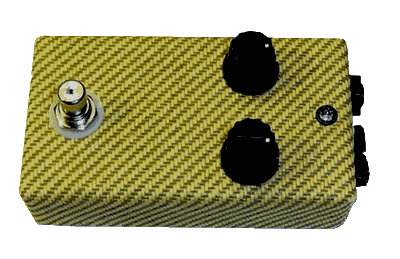
For this particular fuzz design I was inspired by "The Doors" tune "Hello, I love you" from "Waiting for the sun" album. You can try to fake that sound with most of basic distortion boxes, but something will be definitely missing. In addition to plenty of distortion, sustain and wide frequency range ( lots of bottom and high end ), it needs some farty stuttering qualities and specific attack and decay . By testing many different circuits, I ended up with the simplest ( in terms of parts count and straight signal flow) design, similar to those " Heathkits", with one tone control and FET buffer. From modern features - only True By-Pass switching, DC jack and LED indicator included, no noise reduction, etc.
Basic model has Volume and Tone controls, gain set to maximum. It cleans up good enough with guitar volume control, but additional Gain control is available too, for those who prefer footswitchable presets to on-board volume knob.
|
|
strat1
strat2
strat with treble up
strat high gain
ES330 neck pickup, low gain
|
Tweedy - blues driver and treble booster
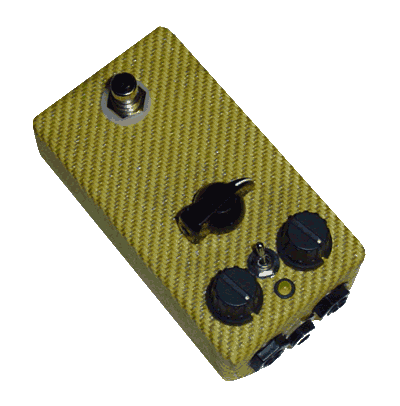
This beauty comes from combining several ideas - soundwise it was tweed Bassman("Tweedy"- is the first box with real tweed cover), six position varitone was inspired by old B.C.Rich Eagle guitar I played back in 1985, and uses inductor coil for tone shaping, treble booster part comes from mysterious Dallas Rangemaster. On top of everything it has three switchable gain settings - low (for humbuckers), medium and high.
Varitone rotary switch acts as a select frequency mid-cut filter, which successfully emulates Fender scooped-mids sound. Input impedance is similar to a tube stage, output- less than 10K.
Controls: Volume, Treble( full CCW is normal, going CW boosts highs), 6-position rotary Varitone switch: 1-tone by passed; 2- lo-mid cut; 3- mid cut; 4- hi-mid cut; 5- low cut; 6- highest gain(fuzz), mini switch- hi/low gain.
True By -Pass On/Off, LED (super bright Blue is avail.), 9V battery, and 9V DC jack.
|
|
oct1+oct2 only
clean+oct1+oct2
clean+fourth
fuzz+oct1+oct2
fuzz+fourth
oct2 only
fuzz+touch of oct1
in front of envelope filter
wacko+oct1+oct2
|
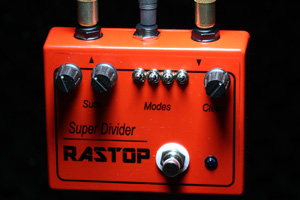
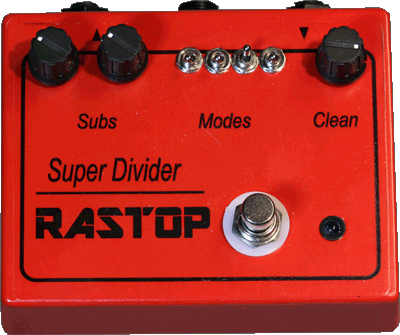
Super Divider
I was fooling around with dividers since late seventies. At that time CMOS chips were not available, so everything was based on discrete transistor flip-flops, but recordings with great sounds were a plenty…
A few of my favorite guitar solos with octave dividers:
Led Zeppelin - "Fool In The Rain" (from "In Through The Out Door")
Jeff Beck - "Come Dancing" ( from "Wired")
Rainbow - "Freedom Fighter" (from "Difficult to Cure")
Rory Gallagher - "When My Baby She Left Me" (from "BBC Sessions")
Almost every music electronics company used to make some sort of divider before and after introducing the DIVIDED pickup ( AKA Roland GK-1). The most sophisticated one IMHO was MXR "Pitch Transposer", with excellent tracking and many unusual possibilities. Most of them are gone for good. Now you still can get BOSS OC-2, a nice box for the money. Do-It-Yourself guys should check Craig Anderton's article in April 1983 issue of Guitar Player magazine, excellent guide in building and playing (very important!) the divider.
New, updated Super Divider features:
Independent (really) volumes for Clean, Octave1 and Octave2 (one and two octaves below original pitch).
"Modes" switches - select octave-up, Wacko, intervals of 5th or 3rd for suboctaves, mixed together with main octave below. For sound samples- visit Youtube
Noise reduction, no sputtering at the end of decay.
Internal trimpots for input gain, tracking, master output volume
Box size : Hammond 1590BB
Standard true By-Pass, LED, 9V battery or external 9V DC power.
|
|
|
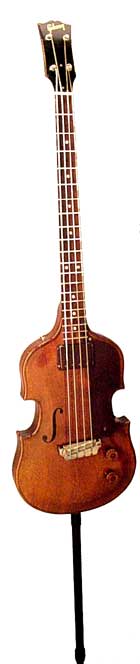
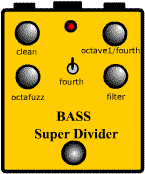
Bass Super Divider
How low can you go?
Only half a year ago I didn't know the answer to this question. Mainly because I never asked it to myself. Octave divider for guitar was a very cool thing, with sounds ranging from analog synths to floor-shaking two octaves below... Still remember some magazine advertisement for octave divider - "now you can play like Eric Clapton and Jack Bruce together, all by yourself!!!"
In the mean time bas players also dug frequency division - Now You Can Play Like Jack Bruce And...
??
Well, maybe Ginger Baker's kick drum...
And YES, you can.
I've got many questions about Super Divider from bass players - love the sound, but will it track?
The answer was NO. Super divider was designed to cover six-string guitar frequency and despite of the analog signal processing tracks pretty good from 5th fret and all the way up.Plugging the bass into it resulted in decent tracking above the 12th fret, but nothing below.
Too bad, but why?
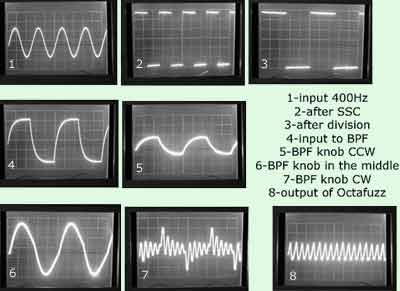
Sine -to- square converter ( SSC) converts a sine wave into pure square wave, which feeds the divider circuitry. Guitar string vibration is a very complex signal source with different amounts of odd and even harmonics, decaying with different times depending on pitch, string gauge, playing position, guitar body resonant qualities, picking intensity/type etc. One of the common mistracking sounds in dividers- "octave jumping", which manifests in toggling between divided and fundamental ( sometimes even different intervals) frequency. If you watch the signal shape in the scope- you'll see that after picking, when signal is strong, the wave is very close to sine with corresponding fundamental frequency. Upon a decay strange things happen, most common - 1st harmonics (octave up) have a longer decay time, than a fundamental. So divided signal follows the pattern- first you hear perfect octave down and than a fundamental kicks in (provided by division of first harmonic frequency). To kill all upper harmonics incoming signal needs filtering, usually low pass filters are used to get only fundamental frequencies to SSC. It's brutally simplified, but gives an idea to those, who ask questions :-)
So that's what I've done to Super divider to adapt it for 4-string bass in standard tuning:
1. First of all the power supply - one 9V battery is too small for a mighty rumble , needs +-15V rails.
2. Substituted "fuzz" with "octafuzz" knob, which gives that clavinet buzz (when playing long sustained notes - great synth vibe) with addition of octave-UP frequency. The overall sound is similar to "wacko" switch in guitar divider. If intervals are processed - 4ths/5ths sound powerful and deeply distorted, seconds/others result with Ring-modulator-like combination frequencies. The last sound sample consists of three clips in the key of A : "octafuzz" +divided signal; "octafuzz" only, and mix of clean/ "octafuzz" /divided.
3.Added "filter" knob ( BPF knob). HI-Q bandpass tunable filter gives plenty of sound choices, including emulating distortion and tuning in different harmonics. Affects only divided sound. Filter can be customized to accept expression pedal/control voltage for real-time control.
4. Eliminated "2octaves below" sound, but left "4th two octaves below" for those who'd like to count amount of speaker movements per second. Example: if you play note E (on G string, 9th fret), you'll get an open A below . Try to play it simultaneously to get the idea.
5. Included extensive filtering to "sinodize" the output for a natural string sound.
6. Included dedicated "Infrabass" output jack for BI-amping ( those who use separate amps for lows and highs and can set a crossover frequency at 80- 200Hz will benefit the most).Recently I use stereo output jack wired this way: tip- main effect;ring- infrabass only, not switchable. If you use normal mono guitar cable, ring safely shorts to the ground.
7. This one should be #1, Bass Super Divider tracks all 4 OPEN strings! (even if octave/fourth jumping happens, it still sounds very smooth) Trimpot inside allows adjustment of tracking sensitivity. Lots of filters... It still needs some practice to get the best sound, but all rules are the same - clean picking ( one note at a time, mute everything else, pick or fingers work well, picking with palm muting gives amazing thump), use the neck pickup (the one which positioned as far from the bridge, as possible) - best with humbucking pickups, but single coils work fine too, just a little more noisy, vary the picking strength from low/normal in low positions to more intense above 12th fret. All samples were recorded with Yamaha BB 350, upgraded with Schecter single-coil pickups, directly into the console.
Controls:
Clean - dry signal volume.
Octafuzz - octave-doubling fuzz volume.
Filter - octave down/fourth tone, variable band-pass filter, emphasizes different harmonics.
Octave/Fourth - divided volume.
Mini-switch - toggles between Octave down / Fourth two octaves down.
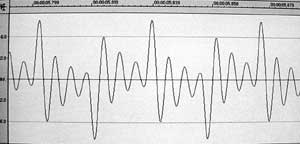
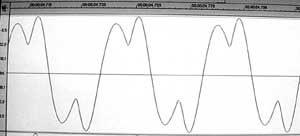
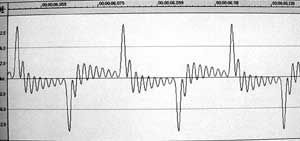
For tech-heads and curious ones I've put three sound files of "Infrabass" output and their corresponding wave forms ( played on bass, photographed from the computer monitor screen, opened in Sound Forge. Watch the harmonic content at different Filter positions. Those of you who have any sound-editing software may open and ANALYZE THAT). Below those files are the photos of scope pics at different points of signal flow, the divider is fed with audio generator at 400Hz. Watch the output of Octafuzz - fundamental frequency is multiplied.
WARNING! The frequencies are VERY LOW, if you don't have a good subwoofer in your computer system- you might hear nothing! Connect your sound card output to a bass amp for best demo.Keep in mind that at very low frequencies amp and speaker start to distort much earlier, than usually.
|
|
|
|
|
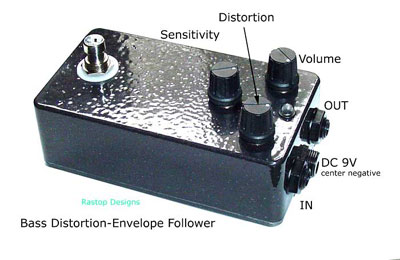
Bass Distortion-Envelope
Portable, 9V powered. Stick it in your gig bag and have fun!
Optocoupler based with MOSFET distortion.
|
|
dry-wet mix
more wet
wet
heavy distorted chords
|
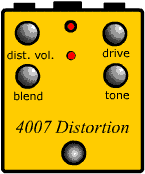
My version of "tube sounding fuzz", analog application of digital chip, some extras too: it has four knobs- Distortion Volume, Blend (you can go smoothly from dry to wet with everything in between, in full CCW position - unity gain for clean), Tone, Drive.
Optocoupler noise reduction (expander)cuts hiss and hum. Two LED's - one for On/Off, second shows when expander kicks in, visual help to fine-tune the box.
Runs on a 9V battery or a 9V DC power supply, true By-Pass.
Listen to nice definition of heavy distorted chord sounds!
|
|
neck humbucker
strat1
strat2
NEW! square wave modulation
|
The very first electronic guitar effect I've made was Tremolo, the very first song I've played with it was "Midnight Special", the CCR version, in November of 1969...
This one is the optocoupler-based, phase- shift based design, which means that in addition to amplitude you get some pitch modulation ( Magnatone freaks anywhere?). For those who like pure square-wave, high speed amplitude modulation, upgrade is available.
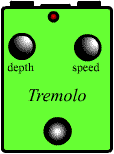
The controls are straight forward - Depth and Speed. Depth takes modulation from zero to 100%, to asymmetrical phase anomalies. LED shows effect On and blinks with corresponding speed. Enclosed in small 110x60x28mm die-cast aluminum box.
Output jack is wired for stereo- use TRS jack and get dry and wet signals separately to two amps or a console.
True By- Pass, 9V battery operated, or 9V DC power supply.
|
|
strat bridge
strat mid+bridge
strat neck high gain
|
393 Distortion
Watch a short video of me playing through the 393!
Download file 393-01distortion.mpg (2.5Mb)
Very unusual design, LM393 comparator in linear (almost ;-) mode, NE571 expander for noise reduction and violin-like, slow attack sounds.
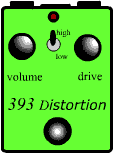
Controls: Volume, Drive, Gain switch - low for dynamic, instrument sensitive distortion; High for Robert Fripp infinite sustain ( adds low end ).
The sound is very midrange-focused, no massive bottom, plenty of artificial harmonics, Jeff Beck's Marshalls shrunk into two by four!
Always true By-Pass, 9V battery or power supply.
|
|
|
|
|
|
Here's the box with Univibe sound cleaned-up and fully conditioned for stage or studio, including stereo output via TRS output jack, 30 volts P-P headroom(means you can hit your strings really hard -no distortion) optocouplers, wide speed range. Two LED's - one for On/Off, second for constant SPEED and DEPTH monitoring ( yeah, DEPTH - you can see how LED goes from steady light to full on -off blinking with all in-between settings. This LED wired in series with optocouplers LED's, so you see exactly what happens inside the phase shift stages). Excellent frequency response, bass guitar sounds awesome, keyboards (Hammonds!) too.
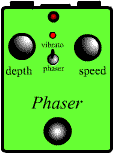
Controls: Depth, Speed, Phase-Vibrato mini- switch
True By-Pass, external power supply only ( included)
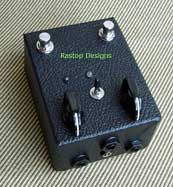
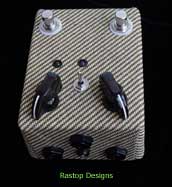
Optional- jack for external speed control via expression or volume pedal, Feedback switch for WAH-like sounds.Take a look at the picture below- it's a Phaser-Tremolo combination box in Tweed.
|
|
|
Gypsy Phaser
A new chapter in Univibe saga...
Two footswitches, one for effect/bypass, second for phaser/vibrato choice. Speed/depth LED, Bi-color phaser/vibrato LED. All options available.
PLUS: GYPSY SWITCH - for hard-core Jimi fans. Flip the mini-switch and enter the Octavia territory. Various mixing possibilities- phaser+ gypsy, vibrato+ gypsy, set the Depth all the way CCW and get just gypsy.Sounds good before and after distortion.
For those who are not familiar with that sound- get "Band Of Gypsys" , play "Who Knows" and at 6:30 you'll hear it...
Check the sound samples and E-mail for pricing!
|
|
|
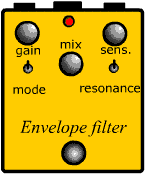
Envelope filter (recently updated )
Fun fun funk! Attention funksters and funkadelics!
Its wild, its optical , its whee-whaa…..
Controls: Gain, Mix (new!) Sensitivity, two mini-switches (new!): Mode and Resonance.
Now you can add some dry non-inverted sound to the mix for a nice sparkle.
Mode selects between full range and high pass frequency sweep, Resonance changes the tuning of the filter.
Just listen to sound samples, especially with Super Divider - anyone scoring porn?
9V battery, True By-Pass, DC jack.( or I can stick it into your guitar cavity : -)
Short video live from the "Bitter End"- here
|
|
|
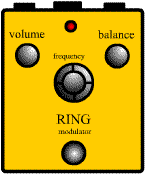
Ring Modulator
Some people hate it, some people love it, Jeff Beck tunes it right and wails.
I agree, a little too scientific, but what a crazy toy!
This one has Balance knob- you add ring modulation to straight( not so straight- its Octave Doubler sound, Octavia vs. Tychobrahe vs. Green Ringer vs.…..)
Controls: Volume, Balance, Frequency
Noise gate for cutting feedthrough frequency.
External power supply only, True By-Pass
NEW! "Envelope" option is available now. Also check sounds at "Bass Ring Modulator" section.
Listen!
|
|
|
Bass Ring Modulator
The latest improvements for bass ( and guitar) players:
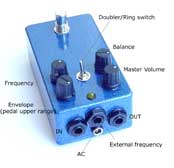
Envelope - changes VCO frequency (initially high, after note played- low and back to high upon decay) according to note envelope."Envelope" knob engages effect and sets maximum frequency, which goes above 10Khz."Frequency" knob sets the lowest frequency of envelope.When "Envelope" knob is fully CCW, "Frequency" acts as usual.
"Balance" knob blends clean (now it's really clean) and effect sounds (0 - 100% range), for Octave Doubler you flip the mini-switch.Check out the rich distortion with doubling!
External jack for expression pedal - control frequency with your foot, ring-o-whammy madness. Set the range with "Envelope" & "Frequency" knobs.
Improved noise/feedthrough reduction
Die-cast enclosure Hammond 1590S (a little wider than 1590N)
All sound samples are recorded with bass guitar.
LISTEN!
|
|
|
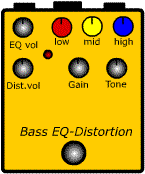
Bass Distortion & EQ
Sounds of bass players/bands I've tried to nail - John Entwistle (R.I.P. John...), John Wetton ( King Crimson, Family, Roxy Music, UK, Asia, Wishbone Ash, Uriah Heep), Mel Schacher (Grand Funk Railroad), Jack Bruce, Chris Squire (Yes). Pretty wide range?
Listen to the sounds!
All recorded through 50W solid state amp and 15" bass Eminence speaker at low volume.
Designed originally for a live rig ( for use with bass amp), this box proved to be an excellent DI with great sound coming from plugging directly to console. Adding variable amount of distortion ( from very subtle to enormous...) successfully emulates tape saturation effect of analog recording.
Standard/custom features include:
Two inputs- high and low sensitivity, to match your axe output. One-input boxes accept both active and passive basses.
EQ section- 3-band graphic(rotary pots), flat in the middle position, voiced for bass.
Distortion section- gain, tone, main EQ independent. MOSFET-based design.
Master section- volume and blend: CCW- pure EQ; CW -pure distortion. In recent models "blend" knob is substituted with individual volumes for EQ and Distortion.
+/-15V supply rails(plenty of clean headroom)
Enclosure - floor stompbox , rack mount, you suggest...
Output section- mono, stereo, balanced- by customer request.
Switching - panel, footswitch, remote. Any combination of EQ/ Distortion/Bypass available.
Sounds:
pick 1
pick 2
fingers
funk 1
funk 2 ( only EQ's active, mid-scooped)
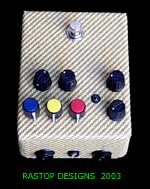
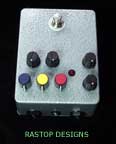
Check out the photos of the stompbox versions of Bass EQ-Distortion :
On the left- simplified version (tweed and gray), one footswitch for engaging/bypassing effect, independent volumes for EQ and distortion.
|
|
|
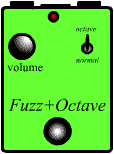
Fuzz + Octave
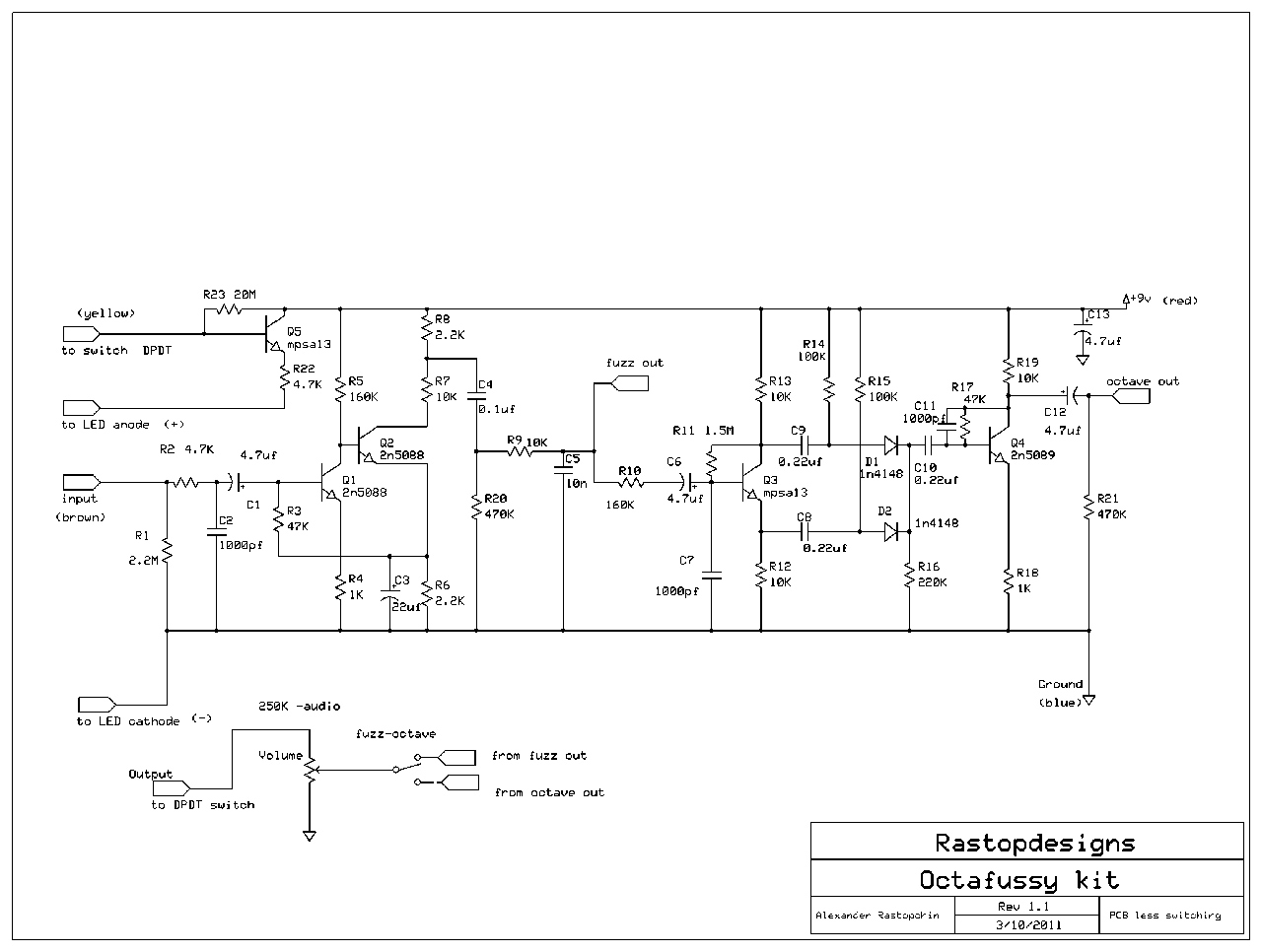
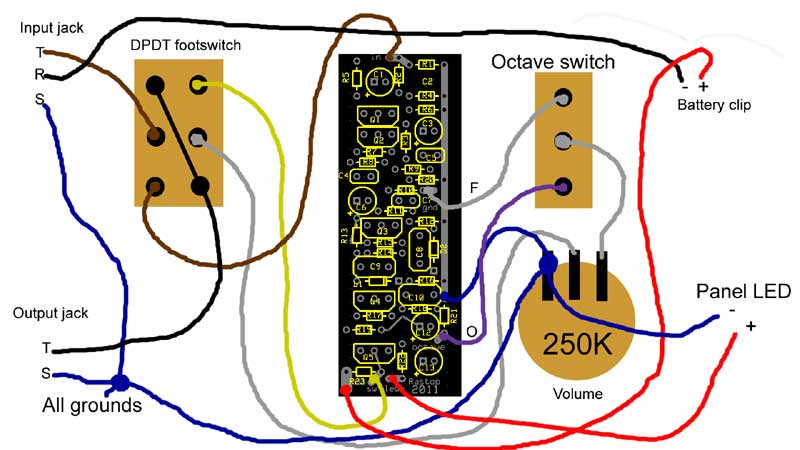
Combination of Fuzz Face and Octavia . One Volume control , one mini-switch to turn on the Octave mode. Gain set at special, best sounding to my ears, level. All silicon modern transistors, low noise, low power consumption.
Great option- turn it into practicing amplifier, 2" ferrite speaker mounted at the bottom. The moment you unplug Output jack - speaker is on! Very nice for practicing artificial harmonics, clean picking etc. at small room levels.
True By-pass, LED, 9V battery or DC power supply.
|
|
Miscellaneous |
|
|
NEW IN 2007!
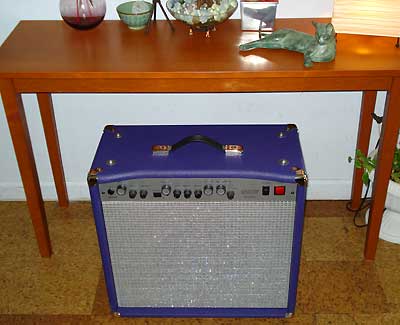
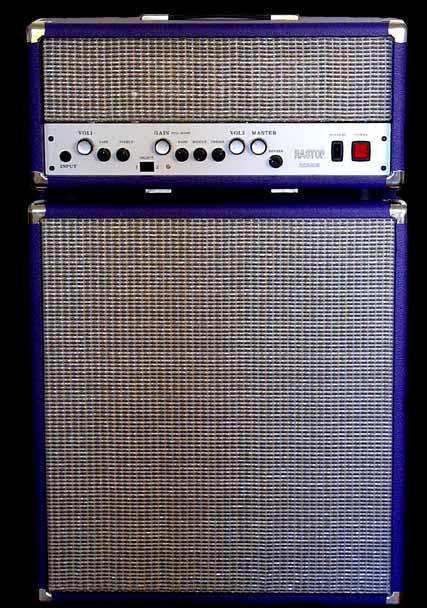
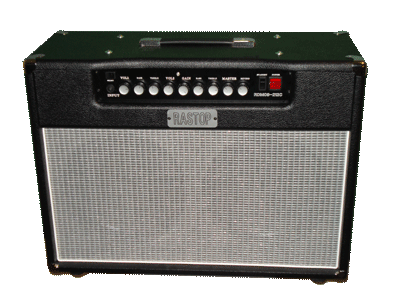
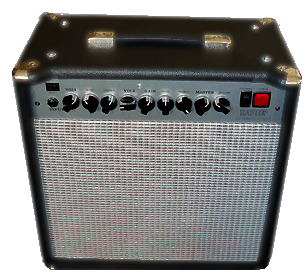
The latest all tube 70W RMS two channel combo RDM07.
Two KT88's at the output. Special Middle control in the Gain Channel, acts as a tunable notch filter.
One 12" 100W NEO Jensen speaker
Reverb
Solid pine cabinet
Ask for it at The Studio!
|
|
|
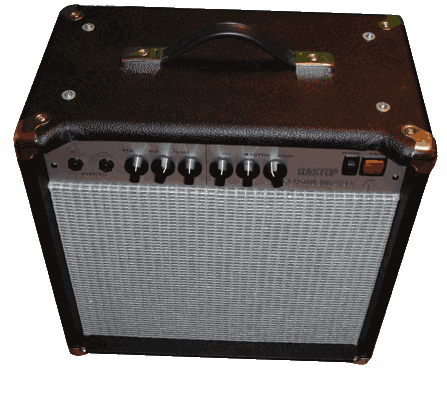
The new addition to my designs - all tube 50W amplifier.Two channels: Clean , ("Fender-type") and Lead, front panel or footswitch selectable. Independent tone controls, Master Volume, Reverb. Point-to-point wiring. Choice of 6L6/EL34/6V6 tubes.
You can try the amp at The Studio, ask for Rastop Designs RDM05 head!
RDM05 head weighs only 29 pounds, about 10 pounds less than a Marshall head!
Matching cabinet is available , special design, two Jensen speakers with neodymium magnets, super light (cabinet weight is 32 pounds). One 10 and one 12 inches speakers have a very clean, wide open sound in an open back enclosure (selected pine wood).Each speaker rated at 100W RMS, standard wiring is in parralel for 4ohm total impedance.
|
|
|
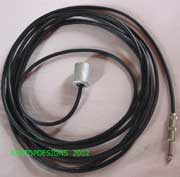
Wired Feedbacker - something relative to E-Bow, but hard wired to cable and connected to the amplifier Ext. Speaker jack. Extremely versatile harmonics, with envelope follower produces cascading whistles and moans. Not for regular blues gig, some of you could've seen me using it at Knitting Factory (with John Macaluso and David Gross). To get the idea- listen to my composition "Just Calm Down" (0.8Mb), and clip from the Knitting Factory show (0.6Mb).
Here's a short video demonstration of Wired Feedbacker . Watch how harmonics change with different positions-
Wired Feedbacker 1.5Mb WMV
|
|
|
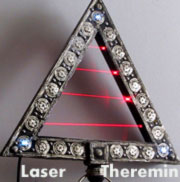
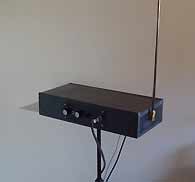
Theremin - I was always a big Theremin fan (invented by Russian engineer Lev Termen in 1920's, he called it TERMENVOX) and built my first one at age sixteen. Nowadays I've built Theremin with laser beams interface for John Macaluso, drummer who never stops looking for new toys. He can use it as a traditional Theremin with two antennas or trigger the sounds with one hand (drum stick crossing four laser beams inside the star-gate looking triangle) and changing the pitch with the other. Really cool!
Sound sample- 110Kb
VIDEO CLIP-990Kb
|
|
|
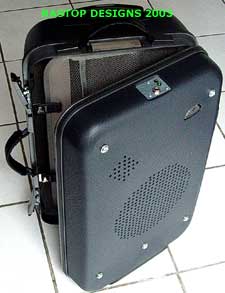
Portable bass amp in a Samsonite case - The latest project for one of the best New York musicians - Miguel Mateus. It's a busker's dream come true!
Battery powered, rechargeable, 10" Eminence speaker plus piezo tweeter.
Plenty of space for luggage/accessories, will travel!
|
|
|
|
|
©2002-2020 Rastop Designs
|
|